Polish church records: what they are and what they can tell you
If your family came from Poland, the answers to most of your questions are written in old parish books. Here is a plain guide to what these books contain, which languages they use, and where they are kept today.
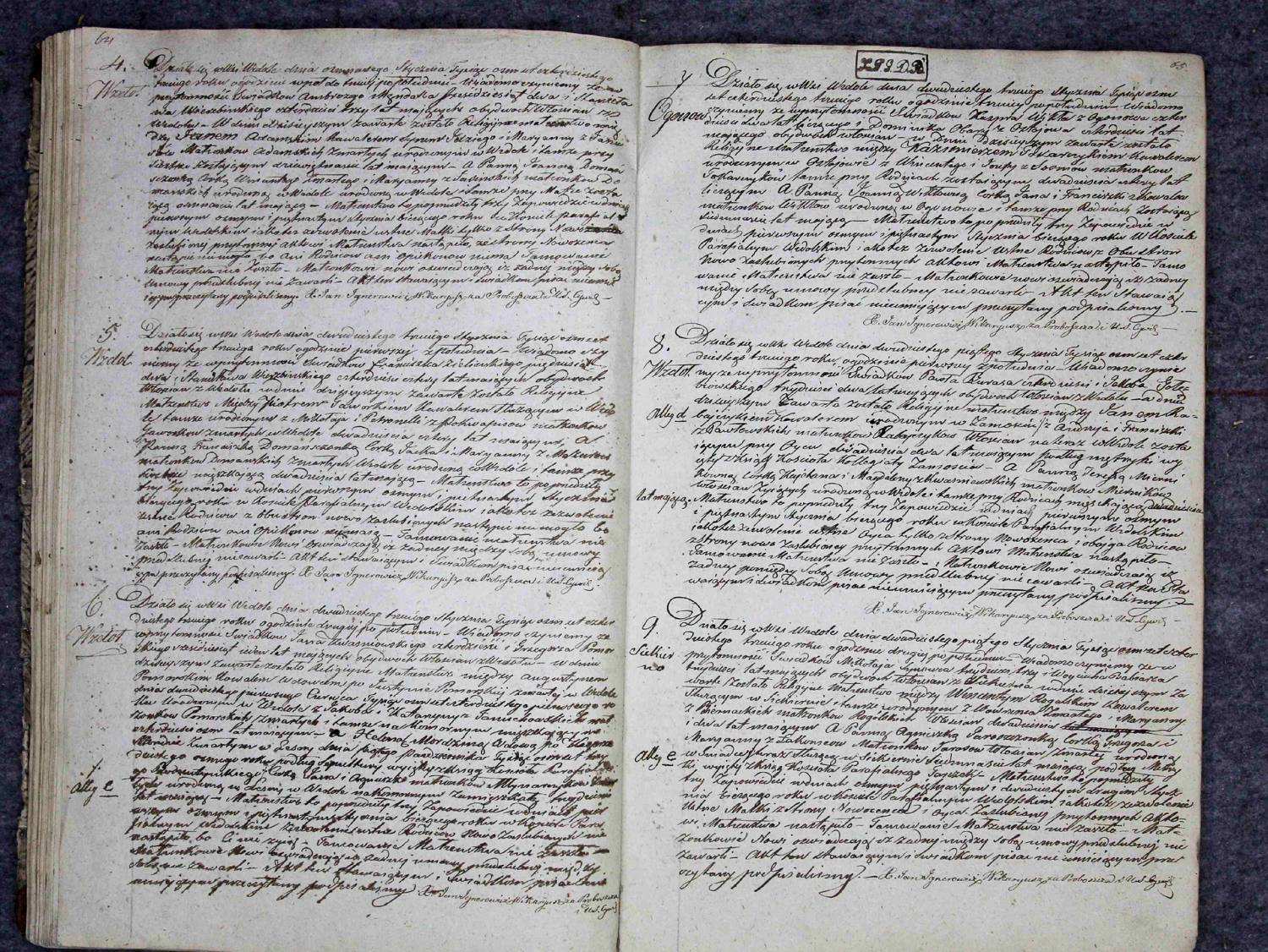
Three kinds of entries
For most of the 1700s and 1800s, the priest of each parish wrote down three things: baptisms (births), marriages and burials (deaths). For families in Poland, these books are usually the best and often the only source about ordinary people.
- Baptism or birth: the child’s name, date, parents, often the mother’s maiden name, the village and the godparents.
- Marriage: the bride and groom, their ages, where they were born, their parents and the witnesses.
- Death or burial: the person’s age, the spouse, sometimes the parents and the cause of death.
One record often leads to the next. A marriage record gives the bride’s and groom’s ages and birthplaces, which tells you where to look for their baptisms, which then name their parents. That is how a family line is followed back, one generation at a time.
Why the language changes
For more than a hundred years Poland was divided between Russia, Prussia and Austria. Each area kept records in its own way, so the language of your family’s records depends on where and when they lived.
| Area | Typical languages | What to expect |
|---|---|---|
| Russian part (central and eastern Poland, e.g. Warsaw, Kielce, Lublin) | Latin before 1808, then Polish, and Russian from 1868 | From 1808, priests kept records that also counted as civil records, written as a story: “It happened in the village of…” |
| Prussian part (west and north, e.g. Poznań, Pomerania, Silesia) | Latin, German, sometimes Polish | From 1874 there were also state civil registers (Standesamt) in German, next to the church books. |
| Austrian part (Galicia: Kraków, Rzeszów, also today’s western Ukraine) | Mostly Latin | Records in printed tables with columns, often with house numbers. Greek Catholic parishes for many families in the east. |
Old handwriting, abbreviations and local spellings make these records hard to read, even for Polish speakers. Names were also written differently over time. In our own example, the same man appears as “Rabayczyk” in the index and “Rabajczyk” in the full record.
Where the books are today
- State Archives in Poland. Many older books are kept in regional state archives. A large part of them has been scanned and can be viewed online through the national portal szukajwarchiwach.gov.pl.
- Civil registry offices (USC). Newer books stay in local registry offices for a fixed time: birth records for 100 years, marriage and death records for 80 years. After that they go to the state archives.
- Diocesan and parish archives. Church copies, and books that never went to the state, are kept by dioceses or parishes. Access rules differ from place to place.
- Indexes made by volunteers. Projects such as Geneteka, run by the Polish Genealogical Society, list millions of entries by name. An index is a great starting point, but it gives only one line and can contain mistakes, so we always open the full record.
When records are missing
Wars and fires destroyed many parish books, especially in 1914–1918 and 1939–1945. When a book is lost, there are often other ways forward: a second copy of the same year kept by the diocese or the civil authorities, records of a neighbouring parish, or gravestones. But sometimes a line simply cannot be continued, and an honest researcher will tell you so.
If you are thinking of paying someone to search, how to hire a Polish genealogist lists seven questions worth asking first.
What you need to start
You do not need much. The most useful facts are a name, an approximate year and a place. If you don’t know the village, family papers often help: emigration documents, naturalization papers, ship lists, church records from the new country, letters and obituaries often name the village or district.
More guides
- How to find your Polish ancestors
- How to find the Polish village your ancestors came from
- Same name, different person
- Polish ancestors from Galicia
- How to read a Polish parish record from 1868–1917 (central Poland)
- Silesian ancestors in Texas
- Free word list for old Polish parish records (PDF)
- Finding your ancestors from the Kielce region
- Your grandfather served with the Polish Forces
- Research example: one woman, several surnames
- How to hire a Polish genealogist: what to check first
- Polish genealogy research: prices and what’s included
- All guides
When it’s worth asking for help
Many people manage the first steps on their own. It gets hard when:
- you don’t know the name of the village the family came from,
- the record is handwritten in Russian or Latin,
- the books for your parish are not online,
- two families in the parish had the same names.
If one of these sounds familiar, start with a free check. Tell me what you know about one family line or one parish. Usually within 3 working days I’ll reply whether and where the parish books for that place are recorded as surviving, according to archive catalogues and online inventories, and which package fits your search. This is a free initial check of catalogues and availability, not the search itself. You pay only if you decide to go ahead with a package.
Ask for a free checkSee packages and prices